

English
A trillion-dollar market opportunity, who will be the ultimate beneficiary?
2019-06-26


In 2017, the market for the construction of the Xueliang Project experienced explosive growth. In 2018, the market continued its rapid growth, accounting for more than half of the entire Safe City construction market. The Xueliang Project has become a new engine driving the construction of China's social security video surveillance system and the sustained rapid development of the security industry, following the Safe City construction project.
So,
How much business opportunity can the construction of the Xueliang Project bring to the security industry?
01
Why is the Xueliang Project so popular?
First, the Xueliang Project was included in the Central No. 1 Document. Therefore, governments at all levels attach great importance to its construction.
The Xueliang Project is an important measure implemented by the Central Political and Legal Affairs Commission and the Central Comprehensive Governance Commission to implement the important instructions on building a three-dimensional and informational social security prevention and control system. It aims to further strengthen the construction and networking of public security video surveillance. It is mainly a monitoring project for rural area security prevention and control, aiming to extend the video image information system downwards to counties, townships, and villages through various comprehensive governance centers and command platforms. It also utilizes system expansion in security, social governance, smart transportation, public services, ecological construction, and other fields. By building various video surveillance points, it aims to achieve "full coverage and no blind spots" in security prevention and control.
In September 2015, the National Development and Reform Commission, the Central Comprehensive Governance Office, and eight other ministries jointly issued "Several Opinions on Strengthening the Construction and Networking of Public Security Video Surveillance," proposing that by 2020, China will basically achieve "full coverage, full network sharing, full-time availability, and full process control" in the construction and networking of public security video surveillance.
The National Conference on Innovation in Comprehensive Social Security Governance held in October 2016 deployed the full-scale implementation of the "Xueliang Project" construction.
A year later, the National Development and Reform Commission, the Central Comprehensive Governance Office, and the Ministry of Public Security jointly approved 48 cities, including Linyi City, as the first batch of national demonstration cities for the construction and networking of public security video surveillance projects, and they received central government subsidies.
In June 2017, the national "Xueliang Project" construction promotion meeting was held in Linyi City, Shandong Province.
In March 2018, the Xueliang Project was included in the Central No. 1 Document for the first time. The central government proposed that building a safe countryside is an important guarantee for implementing the rural revitalization strategy.
In 2019, the Xueliang Project was again included in the Central No. 1 Document, proposing to accelerate the construction of an informational and intelligent rural social security prevention and control system and continue to promote the construction of the rural "Xueliang Project".

This shows that currently, "strengthening security management, promoting the construction of the rural "Xueliang Project," and building a safe countryside have become top priorities in current rural work."
From a construction perspective, the "Xueliang Project" can also be seen as an extension of Safe City construction. Safe City mainly focuses on urban areas, while the Xueliang Project extends the social security prevention and control system to rural areas. The goal of the Xueliang Project is to strive to achieve integrated urban and rural video surveillance. If Safe City protects the "city," then the Xueliang Project connects the city and the countryside. "Xueliang Project, illuminating the path to urban and rural safety" can be considered the most accurate interpretation of the Xueliang Project.
From the application perspective, the application of the Safe City social security video surveillance system is mainly by public security organs, while the Xueliang Project application extends to multiple departments and fields.
The principle of the "Xueliang Project" construction is "Party and government leadership, comprehensive governance leadership, public security responsibility, departmental cooperation, and social participation." The leading and guiding units are the Political and Legal Affairs Commission and the Comprehensive Governance Office, and the specific implementing units are mostly the Public Security Bureaus. The purchasers are mainly the Political and Legal Affairs Commissions, Comprehensive Governance Offices, and Public Security Bureaus of various counties and districts.
Early "Xueliang Project" projects were carried out through cooperation between local governments and broadband network companies, with broadband network companies as the main contractors, due to their strong network coverage advantage in rural areas.
With the full-scale implementation of the Xueliang Project across the country, broadband companies are no longer the only players. Telecom, Mobile, Unicom, and many security and AI companies have also participated, resulting in a diverse landscape.
02
Xueliang Project Business Opportunities Overview
How much business opportunity can the Xueliang Project bring to related industries? Let's look at a set of figures.
By the end of December 2017, Sichuan Province had completed the construction of the "Xueliang Project" in 14,087 villages, with 41,695 new surveillance cameras installed. Among them, Meishan City invested a total of 99.69 million yuan, completing the construction of more than 5,000 front-end video points in 832 key villages (communities), achieving full video surveillance coverage of key locations, transportation arteries, and areas with security difficulties. It also built a city-wide video sharing platform and public security and comprehensive governance application platforms, integrating 15,873 channels of urban and rural public security monitoring video image resources.
By the end of 2017, 2,800 administrative villages in 88 counties (cities and districts) across Guizhou Province had launched the construction of the rural "Xueliang Project," adding 2,160 channels of video surveillance in rural areas. To date, the comprehensive governance centers in 45 counties (cities and districts) in 7 cities (prefectures) across the province have completed the construction of the "Xueliang Project" monitoring platform, networking and sharing 285,257 channels of video surveillance, including 137,000 channels of public security video surveillance and 44,000 channels of social video surveillance on the provincial platform.
In 2017, Shanghai's Jinshan District was designated as a national pilot city for the "Xueliang Project" construction. The district proposed to invest 270 million yuan in the next two years to construct and improve the status quo of public area video surveillance in the district. After completion, the video surveillance coverage rate in key areas of the district will reach 100%.
Chongqing City plans to invest 4.5 billion yuan during the 13th Five-Year Plan period, adding and transforming and connecting 100,000 high-definition video surveillance points and connecting 150,000 social video surveillance points, reaching 335,000 networked and shared video surveillance points, achieving full coverage of video surveillance in key public areas, key industries, and key areas.
Lanzhou will invest an additional 429 million yuan, building 10,000 high-definition points and transforming 2,800 standard-definition points, integrating and networking more than 15,000 video surveillance points in key industries and fields such as water, electricity, gas, banks, hospitals, schools, and stations and wharves across the city, and achieving networked and integrated application of mobile video surveillance for public security, fire protection, and urban management units, striving to build a "full coverage, full network sharing, full-time availability, and full process control" social security video surveillance system.
The "Xueliang Project" construction project in one city and seven counties in Hotan Prefecture, Xinjiang, is expected to have a total investment exceeding 1 billion yuan.
The Phase I project of the Xueliang Project in Shanghai's Pudong New Area has a total investment of 774 million yuan.
In January 2018, the Xi'an Public Security Video Surveillance Construction and Networking Application Project was signed, with a total investment of 786 million yuan. It will build and transform and integrate 45,000 channels of video surveillance, achieving the goal of "full coverage, full network sharing, full-time availability, and full process control" in key public areas across the city.
To date, Hubei Province has deployed more than 1.6 million video surveillance cameras and has uniformly built a three-level security boundary access platform video transmission link at the provincial, city, and county levels. Wuhan, the provincial capital, has 1 million video surveillance cameras. 46,000 of these (Class 1 and 2) are connected to the city's video network. The system has initially formed a social security video surveillance network that completely encloses all city entrances and exits, provides full coverage of key areas, and fully controls road intersections. By 2020, Wuhan will add 44,000 social security video surveillance and multi-dimensional data acquisition front-ends. After completion, the city will have 90,000 Class 1 and 2 surveillance cameras.
In 2017, Changsha significantly increased the construction of surveillance points for the "Snow Bright" project, continuously improving the city's security infrastructure and increasing coverage of key areas. The city has added 20,000 high-definition surveillance cameras, upgraded the Skynet project's basic platform, operational platform, maintenance platform, and electronic card platform, and built a social video resource access and supervision platform and a Skynet project public service platform. The city has 75,000 publicly funded cameras, achieving comprehensive video surveillance coverage.
To date, Shenzhen has built 1.3 million cameras of various types.
The first phase of the Longgang District, Shenzhen "Snow Bright" project invested 300 million yuan, and the second phase invested 600 million yuan. Longgang District was the first in the city to complete the three phases of the "Snow Bright" project and established a public safety video network connecting various government departments. 35 major departments and 11 streets have access to the video network. Over 19,400 high-definition cameras have been installed, achieving full coverage of key areas, roads, and locations. The fourth phase of the Longgang District "Snow Bright" project is estimated to cost 820 million yuan and will include network construction, 6,500 high-definition Class 1 video surveillance points, 40 high-definition card-reading license plate recognition positions, and 1,442 Class 2 and 3 cameras.
To date, Linyi City, Shandong Province has installed a total of 360,000 video cameras, achieving full and seamless coverage. This effectively addresses the issues of weak grassroots prevention and control capabilities, dispersed resources, and limited means.
Ten years ago, only four first-tier cities had 200,000 video surveillance cameras. Now, a single county has over 50,000, and some top 100 counties even have 100,000.
In October 2018, Anhui SiChuang Electronic Co., Ltd. won the bid for the Hefei City Public Security Video Surveillance Construction and Networking Application Demonstration City Project and the Hefei City Video Surveillance System (Phase II) Construction Project, with a bid amount of 637 million yuan. The project will add more than 18,000 front-end video acquisition cameras to the "Skynet", integrate more than 100,000 social video resources, and build a video aggregation access service platform to achieve heterogeneous integration of different monitoring platforms and storage, realizing a unified video surveillance network.
So, what business opportunities does the "Snow Bright" project bring to the security and related industries?
According to the "Thirteenth Five-Year Plan" for the Construction and Networking Application of Public Security Video Surveillance, issued by the National Development and Reform Commission and other departments, by 2020, a public security video surveillance networking application system covering six levels (central, provincial, municipal, county, township, and village) will be basically established. The central government will select around 50 cities annually for key support. From 2016 to 2020, the central government will allocate 10 billion yuan to 250 "Snow Bright" demonstration cities, planning to drive 100 billion yuan in local project investment.
Let's do some calculations. Currently, China has 661 cities, including 4 municipalities directly under the central government, 283 vice-provincial cities, provincial capital cities, and prefecture-level cities, 374 county-level cities, and 1636 counties.
Let's look at the investment at the county level.
In 2018, the "Snow Bright" project in Baishui County, Shaanxi Province, reached 105 million yuan, and the "Snow Bright" project (Phase I) in Weining Autonomous County, Guizhou Province, cost 103 million yuan (Phase I only). If we assume an investment of 100 million yuan per county, the total investment for 1636 counties and 374 county-level cities would reach 201 billion yuan.
Now let's look at the investment in large and medium-sized cities.
The first phase of the "Snow Bright" project in Shanghai's Pudong New Area cost 774 million yuan, which is just one district's investment, and only the first phase; the first phase of the Longgang District, Shenzhen "Snow Bright" project invested 300 million yuan, and the second phase invested 600 million yuan, totaling 900 million yuan for just two phases, and this is only one district in Shenzhen; Yinchuan's project has a total investment of 1 billion yuan, although Yinchuan is a provincial capital city, its size is only equivalent to an ordinary prefecture-level city. After Xinyang City, Henan Province, was designated as a pilot city for the "Snow Bright" project, it invested a total of 1.015 billion yuan in two years. Xinyang is an ordinary prefecture-level city in inland China. Wuhai City and Wuzhong City in Ningxia are both ordinary prefecture-level cities in the west. Wuhai's project investment is 325 million yuan, and Wuzhong's total investment is 300 million yuan.
If we include the investment from municipalities directly under the central government, vice-provincial cities, provincial capital cities, and ordinary prefecture-level cities, it would be at least 800 to 1000 billion yuan.
In other words, the "Snow Bright" project will bring a 300 billion yuan market to the security and related industries. This does not include the cost of later maintenance, which is also a significant market.
02
Who Benefits from the Hundreds of Billions Market?
The "Snow Bright" project has created hundreds of billions of yuan in security opportunities. Who will be the beneficiaries of the "Snow Bright" project construction?
First, the people. The pursuit of a happy life is the basic aspiration of the people, and a happy life cannot be separated from security. Without security, everything is zero.
The "Snow Bright" project is a strategic project related to national security capabilities, a basic project for building a higher-level safe China, and a livelihood project that meets the needs of a better life for the people. Therefore, from the central to local governments, it is highly valued. The central and local governments also provide the greatest support for the construction of the "Snow Bright" project in terms of financial subsidies. When the National Development and Reform Commission, the Central Comprehensive Governance Office, and the Ministry of Public Security approved the first batch of 48 cities as the first batch of national public security video surveillance construction and networking application project demonstration cities, they clearly stated that pilot cities would receive central government subsidies. Multiple batches of central government-issued e-government special projects have included "Snow Bright" project items in some areas in the central budget investment plan, which to some extent ensures sufficient project funds and also motivates local governments.
In addition to receiving some central government financial subsidies, most cities will also receive local government support. For example, Pingliang City, Gansu Province, with a total project investment of 146 million yuan, received 28 million yuan in central government funds; Taiyuan City's total project investment was 158 million yuan, receiving 28 million yuan in central government funds; Wuhai City, Inner Mongolia, with a project investment of 325 million yuan, received 17 million yuan in central government funds. According to the Ningxia Development and Reform Commission's official website, Yinchuan City and Wuzhong City received a total of 56 million yuan in central government funds. Yinchuan City's total project investment is 1 billion yuan, and Wuzhong City's total investment is 300 million yuan.
Central government special subsidies have driven local and social investment, becoming the main model for the construction of the "Snow Bright" project, thus providing financial guarantees for its construction. Taking Quanzhou City, Fujian Province as an example, as a pilot city, Quanzhou City received 20 million yuan in central special subsidies. Quanzhou City has established a guarantee mechanism for the "Snow Bright Project" construction involving the government, departments, enterprises, and social crowdfunding. Up to now, Quanzhou City has built 100,000 "Smart Sky Eye" channels, including nearly 40,000 Class A high-definition cameras, and integrated more than 60,000 video surveillance channels from enterprises, institutions, and villages and towns. In terms of fund raising, it not only stimulated corporate investment but also personal investment. Mr. Chen Yongjian, an overseas Chinese from Anhai Town, Jinjiang City, although he has been living abroad for many years, still cares deeply about his hometown and is enthusiastic about local public welfare undertakings. Mr. Chen Yongjian has successively donated more than 10 million yuan to Anhai Town for the construction of the video surveillance system.
As a people's livelihood project, the construction and application of the Snow Bright Project have made the vast majority of people direct beneficiaries. Taking Suining, Sichuan and Pingyi, Shandong as examples, Suining City has currently built Snow Bright Project platforms in 21 townships and 95 villages (communities) across the city, with a total of 570 newly built video surveillance points, 110 monitoring platforms, and more than 800 households connected to the network. The city has completed the construction of Snow Bright Project security in 300 villages (communities). The Snow Bright Project utilizes existing farmers' broadcast and television networks and mobile phone APPs to access public security video surveillance information to farmers' televisions and mobile phones, mobilizing villagers to monitor videos in real time; Pingyi County, Linyi has achieved full coverage of the Snow Bright Project in all 515 administrative villages in the county. From this, we can see that the Snow Bright Project has greatly enhanced the sense of security among the people in townships and rural areas, especially in weak rural areas.
In Zhao Zhuang Village, Li Que Town, Guangrao County, Dongying City, Shandong Province, in the past, vegetable farmers were afraid of their vegetables being stolen, so they lived and ate in the vegetable greenhouses. The village invested more than 100,000 yuan to install 29 high-definition cameras on the village's three east-west streets, five north-south alleys, and three village entrances and exits, and built a village-level monitoring platform, achieving full coverage of video surveillance in important sections and key areas of the village. The implementation of the "Snow Bright Project" has played a good role in maintaining security in Zhao Zhuang Village, and people can safely park their vehicles at their doorsteps, and they no longer need to lock their doors when they go out or work in the vegetable greenhouses. It can be said that the "Snow Bright Project" has become a "thousand-mile eye" guarding the safety of the people.
Secondly, there are security companies. The biggest beneficiaries are the broadcast and television systems, followed by the telecommunications, mobile, and Unicom systems. Security companies and AI companies have also become the biggest beneficiaries.
Taking Shaanxi Broadcasting and Television as an example, Shaanxi Broadcasting and Television Network is the construction and operation unit of the Shaanxi "Snow Bright Project" designated by the provincial coordinating leadership group for the construction of the Shaanxi "Snow Bright Project". Shaanxi Broadcasting and Television Network relies on its "Qinling Cloud" integrated business and "Snow Bright Project" construction to continuously achieve business transformation and upgrading. To promote the construction of the Snow Bright Project, the company also invested 100 million yuan to establish a "Snow Bright Project" project company—Shaanxi Video Big Data Construction and Operation Co., Ltd. By May 2018, Shaanxi Broadcasting and Television Network had signed 9 "Snow Bright Project" projects in cities, counties, and districts such as Weinan Heyang, Shangluo Zhen'an, and Baoji High-tech Zone, with a total contract value of approximately 800 million yuan. At the beginning of 2019, it successively won bids for the Huayin City Snow Bright Project construction project worth 126 million yuan and the Weinan City Chengcheng County Snow Bright Project worth 158 million yuan.
In the 2018 Snow Bright Project major projects, the broadcast and television, telecommunications, mobile, and Unicom systems all ranked among the top bidders.
Security companies have also become the biggest beneficiaries. Taking Zhongxing as an example, in 2018, Zhongxing successively won bids for the Datong City Public Security Video Surveillance Full Coverage Service Project worth 668 million yuan and the Henan Xinyang Public Security Video Surveillance Construction and Networking Application Project worth 254 million yuan. These two major projects alone totaled 922 million yuan.
In January 2018, Hikvision signed a government PPP project for the construction and networking application of Xi'an City's public security video surveillance with the Xi'an City Public Security Bureau. The total investment of the project is 786 million yuan. According to the agreement, Hikvision will build and transform and integrate 45,000 video surveillance channels for Xi'an City, achieving the goal of "full coverage, full network sharing, full-time availability, and full process control" in key public areas of the city. New second and third-class points will be connected to the platform, connecting 10,000 video images from social units.
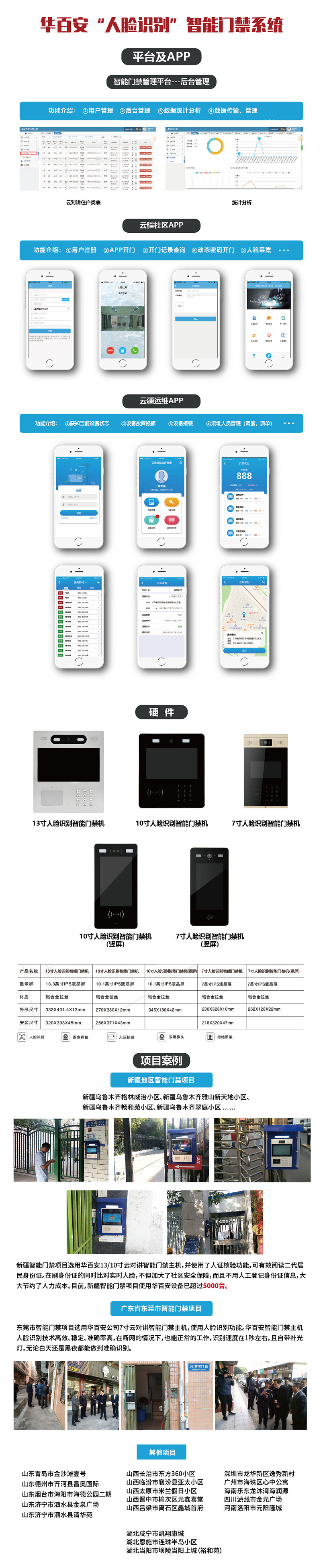
The video access control system consolidates and extends the "Snow Bright Project," serving as the last line of defense for the people at the community and doorstep level.
Welbell Video Access Control Solution It adopts internationally leading facial recognition technology. It supports facial recognition door opening, mobile phone APP door opening, and visitor dynamic password door opening. Importantly, it captures a series of high-definition photos and 15 seconds of video before and after door opening, which can be used for the management of floating population, blacklist comparison, key personnel deployment, and 24-hour video recording, etc.
Video access control business contact information: 18033052020 Zhou Ping


Related Info
Welbell | AI Smart Sports Management System
2023-11-24



Welbell | Smart Campus Management Solution!
2020-03-26





Follow WeChat Official Account
Leave a Message
Customer-centric, thinking what customers think, allowing customers to get satisfactory and high-quality service more quickly.